
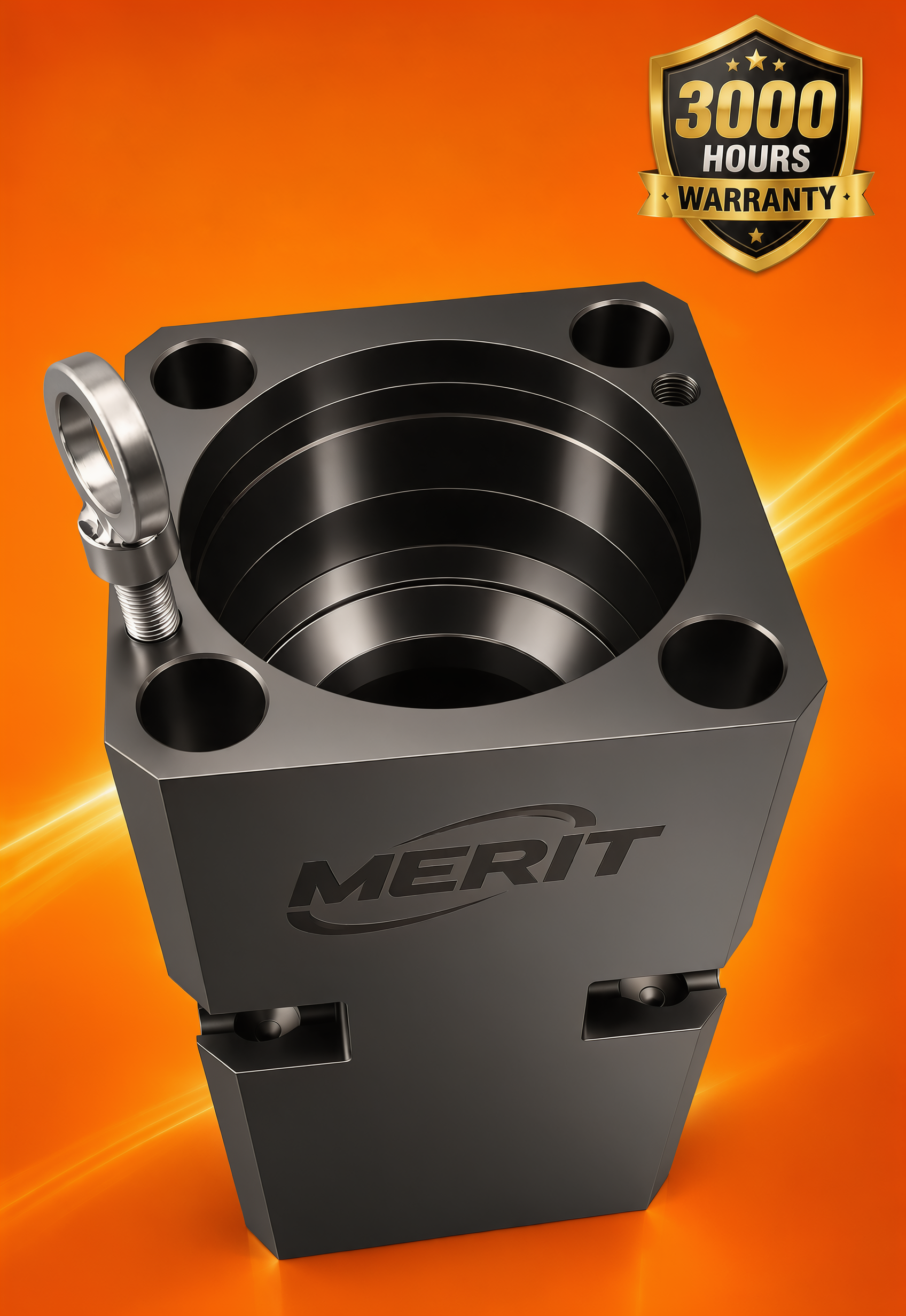
Rammer 2577E Front Head: The Steel Story Behind a Part That Refuses to Quit
If you operate a Rammer 2577E hydraulic breaker on a demolition site, in a quarry, or on a heavy civil project, you already know the front head isn’t just another spare part — it’s the component absorbing the brunt of every single blow. When it fails, downtime isn’t measured in minutes; it’s measured in missed shifts, idle crews, and lost contracts. So before you order your next front head, it’s worth understanding what actually separates a part that lasts thousands of hours from one that cracks in weeks.
Why the Front Head Is the Hardest-Working Part on the Breaker
The front head sits at the business end of the breaker, guiding the tool bushing and absorbing the shockwave that travels back from every impact. It’s subjected to:
- Extreme cyclic impact loading — thousands of strikes per hour, day after day
- Lateral bending stress from side loads during prying or misalignment
- Abrasive wear from dust, rock fragments, and debris
- Heat generated by friction between the tool and bushing
A part facing this kind of punishment can’t just be “hard.” It needs a very specific balance of hardness and toughness — and that balance is engineered, not accidental.
The Metallurgy: Why Alloy Steel and Heat Treatment Matter
A genuine-quality front head starts life as a forged alloy steel billet — typically a chromium-molybdenum grade (similar in family to 42CrMo4 / AISI 4140-type alloys) chosen specifically for its response to heat treatment. Forging, rather than casting, aligns the grain flow of the steel along the shape of the part, which is what gives it the fatigue resistance to survive millions of impact cycles rather than a few thousand.
Once forged, the real work begins:
- Austenitizing — the steel is heated to a precise temperature where its internal structure transforms, preparing it to accept hardening.
- Quenching — rapid, controlled cooling locks in a hard martensitic structure, giving the surface the wear resistance to stand up to constant tool and bushing contact.
- Tempering — a second, lower-temperature heating stage that relieves internal stress and pulls back just enough hardness to leave the core tough and shock-absorbent, rather than brittle.
- Controlled hardness profiling — the goal isn’t maximum hardness everywhere. A well-treated front head has a harder wear surface at the bushing bore and tool contact zones, with a tougher, more ductile core that can flex microscopically under impact without cracking.
Skip or rush any of these stages — quench too fast, temper too little, or use the wrong alloy chemistry — and you get a part that looks identical on the shelf but fails in completely different ways: premature bushing bore wear, hairline fatigue cracks radiating from the tool pin holes, or outright brittle fracture under a side load that a properly treated part would simply shrug off.
The Real Cost of an Under-Treated Part
This is where cheap, uncertified replacement parts quietly cost more than they save. A front head that’s undersized on alloy content or under-treated on hardness might run fine for the first few hundred hours — long enough to pass a quick inspection — before wear accelerates, tolerances open up, and the whole breaker starts hammering itself apart from the inside. By the time the failure is visible, you’re often replacing more than just the front head: bushings, chisels, and sometimes the cylinder housing take collateral damage.
For an asset that represents this much capital investment and uptime pressure, “close enough” steel is never actually cheaper.
Why Source Your Rammer 2577E Front Head from Merit
This is exactly the gap Merit exists to close. Merit supplies Rammer 2577E front heads manufactured to the alloy specification and heat-treatment discipline the application demands — not approximated, not cut short to hit a lower price point. Here’s what that means for you on the job site:
- Correct alloy chemistry matched to OEM-grade specifications, not a generic substitute steel
- Full forge-and-heat-treat process control, so hardness and toughness land in the correct working range — not just “hard enough to pass a file test”
- Dimensional accuracy for a proper fit with your existing bushing and tool assembly, avoiding the misalignment stress that kills front heads early
- Consistency batch to batch, so the part you order today performs the same as the one you ordered last year
- Responsive support from a supplier that understands breaker parts aren’t a commodity — they’re the difference between a productive shift and an idle machine
When you’re comparing suppliers on price alone, ask the question that actually matters: what alloy, and what heat treatment? If a supplier can’t answer that clearly, you’re not comparing two front heads — you’re comparing a real part to a gamble.
The Rammer 2577E front head is only as good as the steel it’s forged from and the heat treatment that steel receives. Get both right, and you get a part that absorbs impact after impact without complaint. Get either wrong, and you’re buying downtime on a delay timer.
Don’t gamble on your breaker’s most stressed component. Source your Rammer 2577E front head from Merit — built on the metallurgy that keeps you running.


